

Top 5 Benefits of Encryption Layers for PHP Scripts
Encryption layers are essential for protecting PHP scripts from theft, tampering, and misuse. They go beyond basic code obfuscation by combining bytecode compilation, encryption, and licensing controls. Here's why encryption layers matter:
- Code Protection: Encryption converts PHP code into unreadable bytecode, safeguarding proprietary logic and algorithms.
- Licensing Controls: Restrict usage to specific domains, IPs, or hardware, ensuring scripts run only under approved conditions.
- Anti-Tampering: Integrity locking prevents unauthorized changes, stopping the application if tampered with.
- Cross-Platform Security: Encode once and deploy securely across Windows, Linux, macOS, and more.
- Flexible Distribution: Enable trials, tiered pricing models, and dynamic licensing without modifying the codebase.
These layers protect intellectual property, reduce piracy risks, and simplify software distribution for developers and businesses. Tools like SourceGuardian make implementing these features straightforward for PHP versions 4.x to 8.4. Encryption isn't foolproof but is a critical part of a broader security strategy.
Scriptcase - Learn how to encrypt your PHP applications
sbb-itb-f54f501
1. Stronger Protection Against Code Theft and Reverse Engineering
By default, PHP files are stored as plain text, leaving them vulnerable to exposure. Business logic, pricing rules, and licensing checks can become accessible to anyone with server access - whether through misconfigurations, compromised accounts, or leaked backups.
Adding encryption changes the game. Encryption layers convert PHP scripts into unreadable, encrypted artifacts that can only run with a dedicated loader. This means even if files are extracted, they’re effectively useless to attackers.
The key protection method here is bytecode compilation. This process transforms readable source code into low-level opcodes. Think of it as serving a fully cooked meal instead of handing out the recipe. During this step, high-level elements like function names, control flow, and comments are stripped away, safeguarding proprietary algorithms and licensing checks. As SourceGuardian explains:
"SourceGuardian PHP Encoder protects your PHP scripts by compiling the PHP source code into a bytecode format, followed by encryption layers."
The encryption doesn’t stop there. Additional layers encrypt the compiled bytecode on disk, ensuring it’s only decrypted in memory during runtime. This creates multiple hurdles for attackers - they’d need to decrypt the files, interpret the opcodes, and bypass integrity checks.
For maximum security, focus on encoding sensitive parts of your code, such as licensing validation, proprietary algorithms, fraud detection, and pricing models. Meanwhile, you can leave customizable front-end views accessible to users.
That said, it’s important to remember that no encryption method offers absolute security. Since code must be decrypted in memory to execute, a highly skilled attacker with full system access could attempt memory inspection. Encryption works best as part of a broader security strategy, which should also include hardened servers, strict file permissions, and secure coding practices.
This layered approach not only protects your code but also opens up possibilities for better licensing controls and more flexible distribution options.
2. Better Licensing Control and Distribution Flexibility
Without encryption, licensing logic is vulnerable - it can be accessed and disabled by anyone with server access. Encryption solves this by embedding licensing logic within compiled, encrypted bytecode. The loader validates this bytecode before the script even runs, ensuring security.
Encryption also gives you the power to restrict scripts to specific environments, such as a particular domain, IP address, or hardware ID. For example, if someone tries to copy your application to an unauthorized server, the loader detects the mismatch and blocks it from running. SourceGuardian supports all three restriction types, letting you tailor the level of control based on the deployment scenario. Whether it's for shared hosting, a dedicated server, or an on-premises setup at a U.S. healthcare facility or financial institution, these restrictions simplify and unify your distribution strategy.
Another major benefit is the ability to use a single codebase for all your customers. Instead of maintaining separate builds for different pricing tiers - like a $49.00/month trial and a $199.00/month enterprise plan - you encode the codebase once and issue unique license files to control feature access for each customer. This eliminates the need to modify the codebase for different plans. If a customer upgrades, all you need to do is generate a new license file - no redeployment required. This approach also works seamlessly for managing trial periods.
To prevent users from bypassing trial limits by rolling back their system clock, encryption layers utilize online time server validation.
Additionally, revoking licenses is straightforward. If a license needs to be canceled - perhaps due to a chargeback or a violation of terms - you can update or invalidate the license file on the server without touching the encoded scripts. By separating the codebase from the license terms, PHP distribution becomes far more adaptable and easy to manage.
3. Smaller Attack Surface and Resistance to Tampering
Plain-text PHP code can be a major weak point in your application's security. Without protection, anyone with access to the files can read, copy, or even alter the code, exposing sensitive logic and routines. Encryption tackles this problem by converting the source code into encrypted bytecode, making it unreadable and preventing attackers from identifying critical security mechanisms. This is the first step in creating a more secure environment.
One of the standout defenses is integrity locking across the entire project. This ensures that all scripts are encoded as part of a unified system. If someone tries to swap out a protected file with an unencoded or mismatched version, the entire application stops functioning. SourceGuardian explains this mechanism clearly:
"Locking of an entire PHP project, so that no protected script can run if any other script is substituted with an unencoded one or encoded with another installation of SourceGuardian. This is ideal for protecting settings, passwords etc within a PHP project."
Another layer of protection comes from environmental key binding. This ties the encryption to specific conditions, like a domain name or IP address. If the encrypted files are moved to a different environment, they simply won’t work. SourceGuardian highlights this feature:
"The domain name is used as a part of the key for encryption, so protected scripts may not be decrypted and run from another domain."
This approach isn't limited to PHP scripts. Even non-PHP files, such as HTML templates, can be encoded within the same project. By doing so, these assets are accessible only to authorized scripts, adding an extra shield to your application's presentation layer and reducing the risk of tampering.
4. Cross-Platform Deployment with Consistent Protection
Deploying protected code across servers can be tricky, but encryption layers offer a reliable solution by maintaining the same protection model across all operating systems.
As highlighted:
"A script encoded under one operating system will run under any other supported operating systems."
This means you can encode your script once - whether on Windows, macOS, or Linux - and deploy it on any supported server without needing to re-encode. Script loaders handle the decryption and execution of your code seamlessly on platforms like Linux, Windows, or FreeBSD. This approach ensures consistent performance across all PHP environments.
SourceGuardian supports PHP versions from 4.x to 8.x and offers loaders optimized for high-concurrency Thread Safety installations. This guarantees stability while maintaining robust protection. By combining bytecode compilation, encryption, and obfuscation, the security remains equally strong, regardless of the platform where the code is executed.
5. Support for Trial Versions and Tiered Commercial Models
Encryption layers make it possible for developers to monetize a single codebase across various pricing models. With one protected build, the software can adjust its functionality based on the assigned license - whether it's a free trial, a basic Starter plan, or a comprehensive Enterprise license. These trial controls build on the licensing features discussed earlier.
Trial versions allow you to share a fully functional, time-limited build without requiring an upfront purchase. Once the trial period ends, the software stops functioning, with encryption layers verifying the expiration date through online time servers.
"SourceGuardian for PHP can also easily produce trial versions of your scripts by setting an expiry date for your PHP scripts or by limiting the number of days that your protected script will work."
This trial functionality seamlessly supports more sophisticated, multi-tier commercial models. For instance, vendors can offer a Starter license with essential features, a Pro license with advanced tools like recurring billing, or an Agency license designed for multi-client management - all from the same encrypted codebase. SourceGuardian’s built-in license generator simplifies this process by creating external license files tailored to each user, while its command-line interface automates license generation during checkout.
Beyond trials and tiered licensing, locking options provide another layer of security for commercial distribution. These options ensure that licenses only function in approved environments, preventing unauthorized sharing - all without requiring the application to be hosted.
Comparison Table
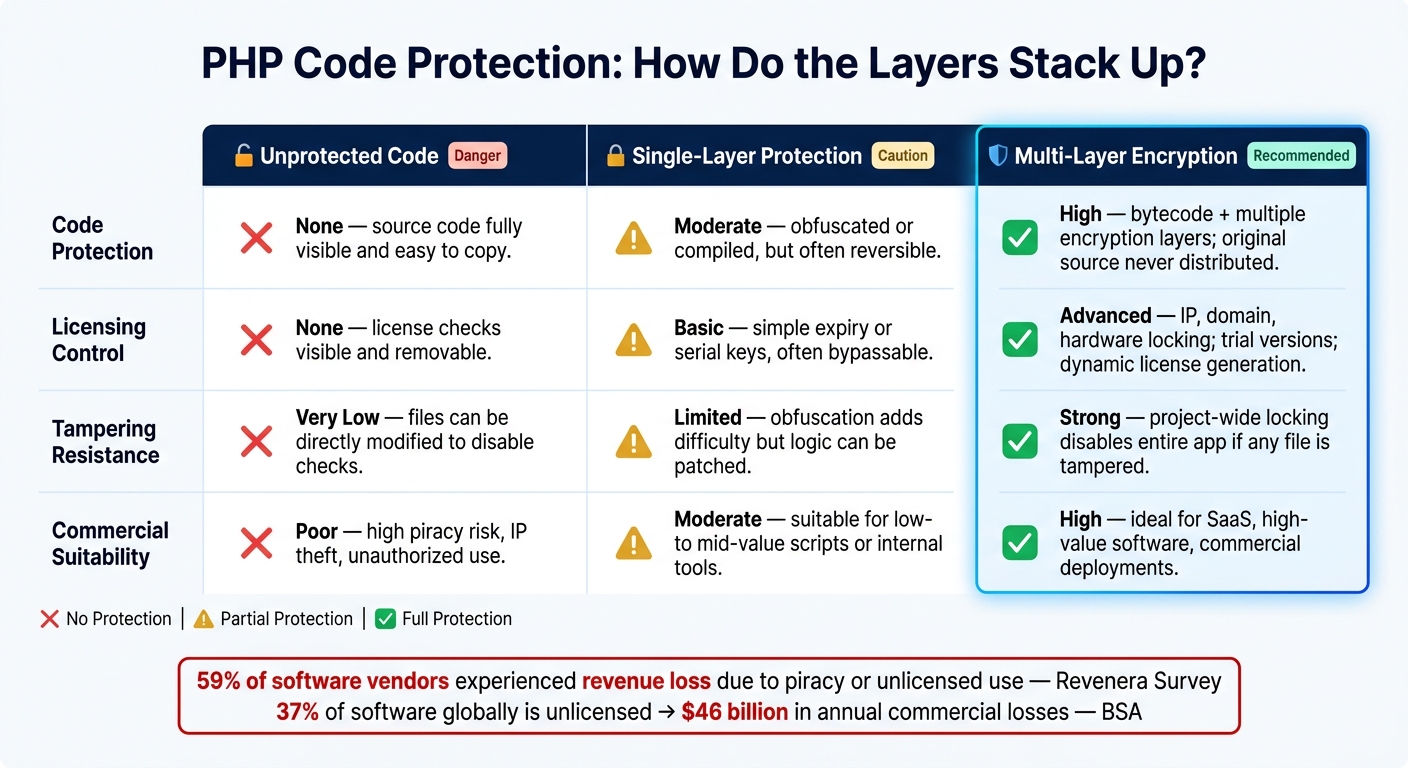
PHP Code Protection Levels: Unprotected vs. Single-Layer vs. Multi-Layer Encryption
PHP security measures range from leaving source code unprotected to implementing multi-layer encryption, each offering different levels of security and commercial application. The table below highlights how these approaches stack up across four key areas relevant to developers and software vendors.
| Criteria | Unprotected Code | Single-Layer Protection | Multi-Layer Encryption |
|---|---|---|---|
| Code Protection | None; source code is fully visible and easy to copy | Moderate; code is obfuscated or compiled into bytecode but can often be reversed | High; compiles PHP source into bytecode with multiple encryption layers, ensuring the original source is never distributed |
| Licensing Control | None; license checks are easily visible and removable | Basic; includes simple checks like expiry dates or serial keys, which can often be bypassed | Advanced; supports IP, domain, or hardware locking, trial versions, and dynamic license generation |
| Tampering Resistance | Very low; files can be directly modified to disable checks | Limited; obfuscation adds some difficulty, but logic can still be patched after decoding | Strong; project-wide locking ensures that tampering with any protected file disables the entire application |
| Commercial Suitability | Poor; high risk of piracy, unauthorized use, and intellectual property theft | Suitable for low- to mid-value scripts or internal tools | High; ideal for high-value software, SaaS components, and commercial deployments requiring strong IP protection and licensing enforcement |
The table clearly shows how multi-layer encryption enhances security, licensing, and resistance to tampering, making it an excellent choice for commercial software. For instance, a U.S.-based agency deploying a custom PHP billing solution can use domain locking to prevent unauthorized code reuse. Similarly, a $99 PHP plugin can leverage trial periods and expiration enforcement to protect its value - demonstrating the versatility of advanced encryption across different business scenarios.
A Revenera survey revealed that 59% of software vendors experienced revenue loss due to piracy or unlicensed use, emphasizing the critical need for strong protection in commercial software distribution.
SourceGuardian addresses these challenges by compiling PHP into encrypted bytecode, with loaders handling decryption and enabling integrated licensing features like IP, domain, and hardware locking, as well as trial version support.
Conclusion
Encryption layers offer a solid defense for protecting your PHP assets. By transforming your code into encrypted bytecode, you make it much harder for anyone to copy, alter, or reverse engineer your work - whether it’s a competitor, a malicious actor, or even a client who might try to bypass licensing terms.
For developers and agencies in the U.S., the financial impact of unlicensed software is striking. According to the BSA, 37% of software globally is unlicensed, leading to an estimated $46 billion in commercial losses annually. By using encryption layers along with domain, IP, or hardware locking, you can significantly limit unauthorized redistribution.
Encryption also supports flexible business models. It allows you to implement features like time-limited trials, tiered product editions, and subscription-based licensing - all from a secure codebase. This aligns well with common U.S. market strategies while safeguarding your intellectual property.
To maximize these benefits, start by identifying the core logic in your PHP projects, define your licensing strategy, and choose a tool that fits your environment. For instance, SourceGuardian works with PHP versions from 4.x to 8.4 on Windows, Linux, macOS, and FreeBSD. It also includes built-in licensing controls, offering a comprehensive solution for encoding, encryption, and licensing.
FAQs
Will encrypted PHP scripts still run on my hosting provider?
Yes, encrypted PHP scripts can run on your hosting provider as long as the SourceGuardian loader extension is installed. Many shared hosting providers already have this set up. However, if you're using a self-managed server, you might need to install and configure it yourself. To make this process easier, you can use the Loader Assistant to identify the right loader for your server. Once installed, check your phpinfo output to ensure the loader is active.
What licensing limits can I enforce with encryption layers?
Encryption layers provide a way to enforce licensing limits, safeguarding your PHP scripts. With these layers, you can restrict scripts to specific environments - like a particular domain, IP address, or server hardware - effectively blocking unauthorized use. You can also implement time-based restrictions, such as trial periods or subscription-based access. These protections are embedded directly into the encrypted bytecode, ensuring robust server-side validation that's difficult to circumvent.
What parts of my PHP app should I encrypt first?
When it comes to safeguarding your code, prioritize encrypting critical business logic, proprietary algorithms, and sensitive data such as passwords and configuration settings. A tool like SourceGuardian can help secure your entire project by locking it down, ensuring that your scripts operate as a cohesive system while preventing unauthorized file replacements.
For added control, separate any trial-specific logic into distinct modules. This allows you to manage licensing and expiration settings more effectively. Additionally, extend this protection to non-PHP files, such as HTML templates, by restricting access through your encrypted scripts. This ensures that every part of your project remains secure.