

How Dynamic Licensing Secures PHP Code Distribution
Dynamic licensing is a modern approach to protect PHP code by tying its usage to specific environments, such as a server's domain, IP address, or hardware. Unlike traditional methods, it prevents unauthorized access or modifications by encrypting PHP scripts into bytecode, which can only run with a valid license. This approach addresses key challenges in PHP code distribution:
- Prevents misuse: Stops piracy, redistribution, and tampering with code.
- Customizable licenses: Allows for time-limited trials, subscriptions, or perpetual licenses tied to specific servers.
- Automated licensing: Generates and delivers licenses instantly during online purchases.
- Runtime restrictions: Ensures the software only operates in approved environments.
Tools like SourceGuardian simplify this process by offering advanced features such as bytecode compilation, domain/IP locking, and integration with CI/CD workflows. This ensures PHP developers can protect their intellectual property while maintaining control over how their software is used.
Scriptcase - Learn how to encrypt your PHP applications
What Is Dynamic Licensing?

How Dynamic Licensing Works: From Encoding to Runtime Validation
Dynamic licensing is a security approach designed to control who can use your PHP applications and under what conditions. Instead of relying on checks embedded in plain-text code - which can be easily bypassed - this system requires a valid license for PHP bytecode to execute. A dedicated loader validates the license at runtime, making it extremely difficult to bypass.
What makes dynamic licensing stand out from traditional static methods is its flexibility. You can adjust or renew license terms, like extending expiration dates or modifying domain restrictions, without needing to re-encode or redeploy your software package. This adaptability ensures a robust and efficient way to enforce licensing terms.
How Dynamic Licensing Works
Dynamic licensing creates unique license files or keys that are customized for specific users or environments. These licenses are often linked to identifiable server characteristics, such as an IP address, domain name, MAC address, or hardware Host ID. When the software runs, the loader checks that the license matches these attributes (e.g., domain "example.com"). If the software is moved to a different environment, it won’t run.
In some setups, the domain name or IP address is integrated directly into the encryption key. This ensures the script cannot be decrypted or executed on an unauthorized server.
To streamline operations, automated tools can handle license generation during online sales. For example, when a customer completes a purchase, the system can automatically create and send a unique license file - eliminating the need for manual processing.
Main Benefits of Dynamic Licensing
Dynamic licensing offers several advantages that strengthen PHP code security. One of its key strengths is the granular control it provides over how and where your software is used. By issuing unique license keys, you can track customers and identify the source if your protected software is found on unauthorized platforms.
This system also supports a variety of licensing models. You can offer time-limited trials that expire after a set period, subscription-based access that renews automatically, or perpetual licenses tied to specific hardware. To prevent users from tampering with trial periods by changing their system clock, dynamic licensing can use online time servers for verification.
For developers, dynamic licensing integrates smoothly into professional workflows. For instance, SourceGuardian PRO, released in May 2024, includes advanced support for dynamic licensing, making it compatible with CI/CD pipelines.
How Dynamic Licensing Protects PHP Code
Dynamic licensing works by securing PHP scripts at the bytecode level, where the code is compiled into a binary format and then encrypted. This approach ensures that attackers can’t simply open your files in a text editor and tamper with them.
Enforcing Licenses with Dynamic Restrictions
The standout feature of dynamic licensing is environment-specific locking. When encoding your PHP scripts, you can bind them to specific server attributes, such as IP addresses, domain names, MAC addresses, or unique machine identifiers. This creates a strong defense: if someone attempts to copy your software onto another server, it won’t function.
For example, using options like "encode-to-domain" or "encode-to-IP" ties your software to the server's identity. As SourceGuardian explains:
"The domain name is used as a part of the key for encryption, so protected scripts may not be decrypted and run from another domain. This is very powerful."
For larger applications, project-wide locking adds an additional layer of security. This feature ensures that all encoded scripts work as a unified system. If someone tries to replace one of your protected files with an unencoded or altered version, the entire application stops running. This prevents attackers from blending legitimate code with malicious scripts.
These runtime restrictions naturally reinforce other methods used to prevent reverse engineering.
Stopping Reverse Engineering and Code Tampering
Dynamic licensing combines bytecode compilation and obfuscation to make reverse engineering almost impossible. Your source code is transformed into a binary format and encrypted with multiple layers of protection. Even if someone gains access to the encoded files, all they’ll see is unreadable binary data.
This layered approach creates a multi-tiered defense. Each component addresses a specific threat: bytecode encoding blocks direct access to the code, encryption prevents unauthorized decryption, obfuscation scrambles the logic, and runtime restrictions enforce strict usage rules. Overcoming all these barriers at once demands an extraordinary level of expertise and resources, which most attackers are unlikely to have.
In addition to safeguarding against unauthorized use, dynamic licensing provides precise control over how your software is used.
Managing Trials and Subscriptions
Dynamic licensing doesn’t just protect your code - it also simplifies trial and subscription management. You can set specific expiration dates for trial versions or restrict the software to a set number of operational days. To ensure accuracy, the system can verify dates using online time servers.
For subscription-based models, dynamic licensing automates the entire process. When a customer makes a purchase, a unique license file is generated automatically using a command-line tool. If their subscription lapses, the software stops working until the license is renewed. Similarly, extending a trial or upgrading a plan is as simple as issuing a new license file - no need to re-encode or redeploy the application.
This system changes how PHP applications are monetized. Instead of relying on one-time licenses that are hard to enforce, you can adopt recurring revenue models with built-in, automated protection mechanisms.
sbb-itb-f54f501
Using SourceGuardian for Dynamic Licensing
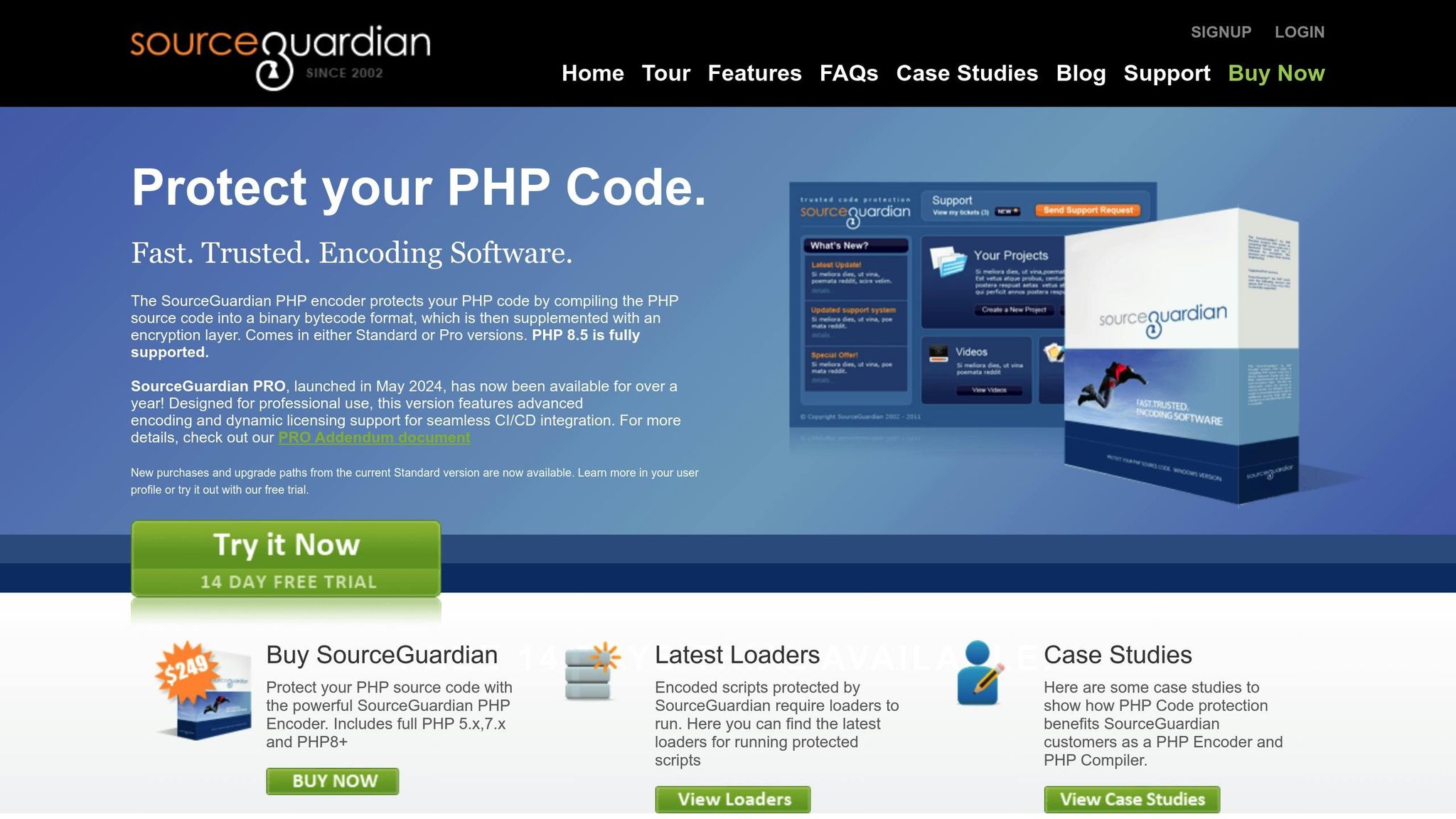
SourceGuardian takes dynamic licensing to the next level by providing tools that enforce stringent security measures. It supports PHP versions 4.x through 8.4 and is available in two versions: Standard and PRO. The PRO version, introduced in May 2024, is tailored to support continuous integration and delivery workflows in cloud environments. Let’s dive into how SourceGuardian’s features enhance dynamic licensing and explore practical ways to use them.
SourceGuardian Features for Dynamic Licensing
SourceGuardian includes a versatile license generator accessible through both graphical and command-line interfaces, making it easy to integrate with online sales platforms. As SourceGuardian notes:
"The SourceGuardian license generator tool... dynamically generates licenses and this would be useful (for example) when selling scripts online."
The software also supports environment-specific licensing restrictions. For instance, you can set hard expiration dates or limit operational days for trial versions. To prevent tampering with local system clocks, it utilizes atomic online time server verification.
How SourceGuardian Protects PHP Code
SourceGuardian employs multiple layers of protection to secure your PHP code. It compiles source code into binary bytecode, encrypts it further, and uses obfuscation techniques for added security. Features like "encode-to-IP" or "encode-to-domain" ensure that scripts are tied to a specific server or domain. This means the script won’t run on an unauthorized server, adding an extra layer of control.
Additionally, the project-wide locking feature ensures all encoded scripts work together as a single system. Loaders required to run these encoded scripts are available at no cost and are compatible with a variety of operating systems, including Windows, Linux, macOS, FreeBSD, and OpenBSD.
Practical Examples of SourceGuardian in Use
The command-line interface makes it easy to automate licensing workflows. For example, when a customer purchases your software through an e-commerce platform, the system can instantly generate and deliver a unique license file. In subscription-based models, this automation ensures the software stops functioning when the subscription ends, resuming only when a new license is issued.
SourceGuardian offers a 14-day free trial, allowing you to explore its features before committing fully. Encoded scripts are cross-platform compatible, meaning you can develop on Windows, deploy on Linux servers, and distribute your protected application effortlessly. This flexibility ensures your code remains secure across different environments.
Conclusion: Improving PHP Code Security with Dynamic Licensing
Dynamic licensing offers a smarter way to protect and distribute PHP code. Unlike basic obfuscation, which often falls short in preventing unauthorized sharing, this method gives you precise control over where and how your scripts are used. By tying your code to specific IP addresses, domains, or hardware identifiers, you can effectively block unauthorized execution.
On top of that, dynamic licensing simplifies operations by automating processes like license generation and trial management. It even incorporates online time verification to ensure licenses remain valid. For businesses relying on proprietary PHP applications, this level of security not only protects revenue but also minimizes losses from unauthorized distribution.
Take SourceGuardian, for example. It combines bytecode compilation, encryption, and obfuscation to deliver robust protection. The PRO version, released in May 2024, goes a step further by supporting CI/CD workflows, seamlessly integrating code protection into existing development pipelines. With compatibility for PHP versions 4.x through 8.4 and support across Windows, Linux, macOS, and FreeBSD, SourceGuardian ensures your scripts perform reliably across various platforms.
Dynamic licensing also introduces unique license files that allow for traceability, making it easier to identify unauthorized use. This added accountability discourages illegal sharing. As SourceGuardian explains:
"If you lock your files to your license file, generate licenses either online or offline for your customers then this will be the best method of protection."
With over two decades of experience in securing PHP code, SourceGuardian has become a trusted choice for developers looking to safeguard their intellectual property. Whether you're selling scripts, managing subscription-based software, or distributing commercial applications, dynamic licensing delivers the control and security needed to meet the demands of modern PHP distribution.
FAQs
How does dynamic licensing protect PHP scripts from unauthorized distribution?
Dynamic licensing provides an effective way to secure PHP scripts by connecting them to a license file that's validated during runtime. This file can impose restrictions like IP address, domain, hardware, or time-based limits, ensuring that unauthorized copies of your script cannot run.
By implementing these runtime checks, dynamic licensing ensures your code functions only in the environments and under the conditions you define. This creates a strong security measure for distributing your PHP scripts.
What advantages does dynamic licensing offer for securing PHP code?
Dynamic licensing gives you more control and options when distributing your PHP code. Unlike static license keys, it allows for features such as time-limited access, locking licenses to specific IPs, domains, or hardware, and even creating trial versions. These tools ensure your scripts are used exactly how you intend.
It also supports real-time updates, letting you modify or revoke licenses instantly if necessary. This added flexibility not only boosts the security of your scripts but also provides developers with greater confidence when managing their code across different environments.
How can I integrate dynamic licensing into my CI/CD pipeline for PHP projects?
Dynamic licensing can become a natural part of your CI/CD pipeline by automating the creation and integration of license files during the build process. Tools like SourceGuardian allow you to generate license files tied to specific parameters - such as a domain, IP address, or hardware ID - and embed them directly into your PHP scripts during the encoding phase. This approach ensures that every build artifact is secured with its own unique license.
To implement this, you can add a license-generation step to your CI workflow, whether you're using GitHub Actions, GitLab CI, Jenkins, or another tool. After generating the license, encode your PHP scripts with it, ensuring the artifact is ready for deployment. At runtime, the license is automatically validated, safeguarding your code. You can also automate processes like license renewal or revocation, adding another layer of flexibility and security to your workflow. This makes dynamic licensing an effective and secure solution for protecting your software.